Skip to content
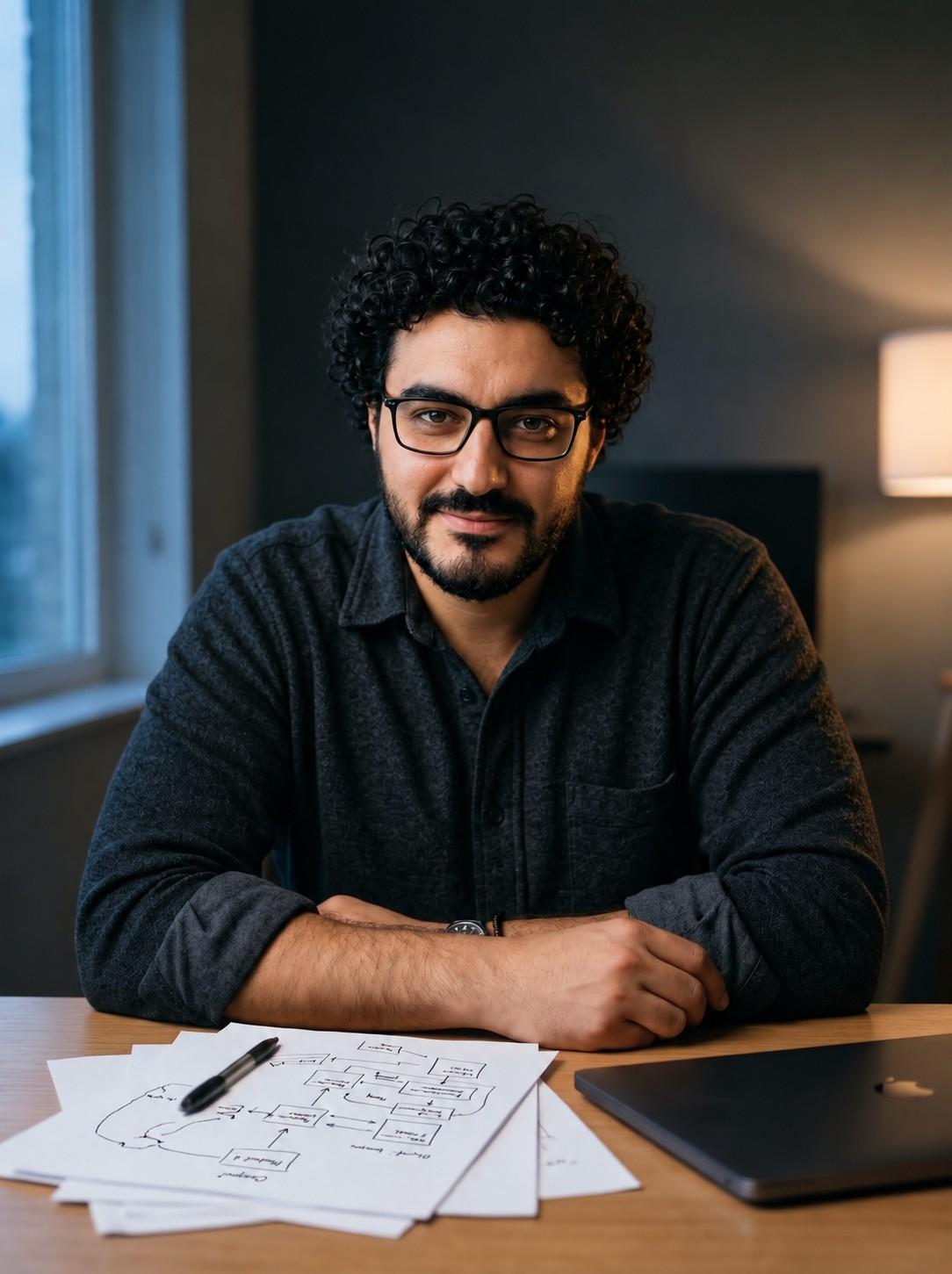
Mohamed Farahat at a wooden table before dawn, leaning in and listening, a notebook with a sketched system in front of him and a closed laptop pushed to the side.

People bring me what they can't make sense of.They leave seeing the whole picture.

I'm Mohamed Farahat. Engineer, team lead, teacher, and builder, based in Egypt and working with teams in the US, the Gulf, and at home. AI runs through almost everything I make, and I decide where it goes.

The title changes from room to room. What people come back for doesn't.

Open to senior engineering and product leadership roles, and to the right conversations.

What people bring me

Real requests, from real people. Different rooms, every time.

  • “Own this product, from the first sketch to production.”
  • “Lead our engineers.”
  • “Take our whole digital presence. The software, the site, the camera.”
  • “Put our practice online, all of it.”
  • “Build us a marketplace for Saudi Arabia.”
  • “How do we put AI into the way we actually work?”
  • “Produce our training films, start to finish.”
  • “Which job should I take?”
  • “What should I learn next, and what should I ignore?”
  • “Explain this physics chapter so it finally makes sense.”
  • “Run the restaurant.”

Different rooms. The same request underneath:make this clear, then make it work.

How I work

I ask why before I ask how.

When I meet a new technology, I don't start with its docs. I start with the problem it was invented to solve, and how people handled that problem before it existed. Once I know the history, I know what the tool is really for, and when to leave it alone.

It's why engineers call me before they pick a stack, a course, or a job.

Reading a technology backward, from the tool to the reason it exists.

I make it make sense.

I can explain the same thing to an engineer, a CEO, and a first-year student, and each of them walks away with all of it. I work out what you already have, find the one piece you're missing, and build the explanation around that gap.

“If I tried to explain this for a hundred years, I couldn't explain it the way you did.”

Someone I taught

I'm easy to hand things to.

On day one I learn how your team works before I suggest anything different. I pick up the thing nobody owns. I hand work over so cleanly that the next person doesn't need to call me.

“You made us love being led.”

She had always dreaded meetings with managers. With us, she said, she looked forward to them.

An engineer I led

I drive the AI. It doesn't drive me.

I use AI in almost all of my work: code, video, voice, automation, and the way I teach. What's different is where the decisions sit. I learn how each kind of model works, what it's good at, where it breaks, and what it costs, and then I hand it the work it's good at and keep the judgment.

When a model reading flight screenshots started adding a day to some trips, I found the exact kind of flight it misreads. When a synthetic voice drifted toward the wrong accent, I found out it was the model underneath, not the voice. When an agent built a whole marketplace and reported every check green, I called it version zero and tested it anyway.

The machine gets

  • The first draft
  • The search
  • The repetitive checks
  • Generated footage
  • Reading a screenshot
  • The first cut

I keep

  • The plan
  • The decision
  • What done means
  • The review
  • The accent approval
  • The final cut
The work splits the same way in every room.

Three small stories

The kind of thing I notice. Each one is a door into a room.

Stored: Sep 7Read as midnight UTCShown in the US: Sep 6Fixed: Sep 7

The date that moved back a day.

A concierge saw a flight's date one day early in a list, and correct everywhere else. The code was reading a plain date as midnight UTC, which is still the day before across the United States. I fixed how every date is read, not just the one screen, and pinned the tests to New York time so it can't come back.

The label said: Egyptian

The ear said: Gulf

A native listener approves

The voice that sounded Gulf.

The first sample I generated for a training film in Egyptian Arabic sounded like the Gulf. The voice itself was fine. It had been paired with a newer speech model that pulled the accent. Now no lesson ships until a native Egyptian listener approves it, whatever a provider's label says.

Never checked

What we actually need

The document nobody had checked.

A client arrived with a detailed requirements document. Before building more, I spent hours with the people who would use the product. They described something else. The document had been written with AI and never checked against their needs. Finding that out early is most of what a technical lead is for.

The room I'm building

Neuroom is my company, being established in the UAE. The name is the promise: whoever you are, we help you find a new room in your industry, or add a new one to the room you already have.

It will hold the products I build myself, and the work I do with clients. UAE first. Then Europe, Egypt and Africa, and the US.

Software and AI, automation, video and ad production, and digital design, with the thinking that comes before all of them.